+1 (216) 400-5753
 521 Valcour Rd, Catonsville, MD 21228, US

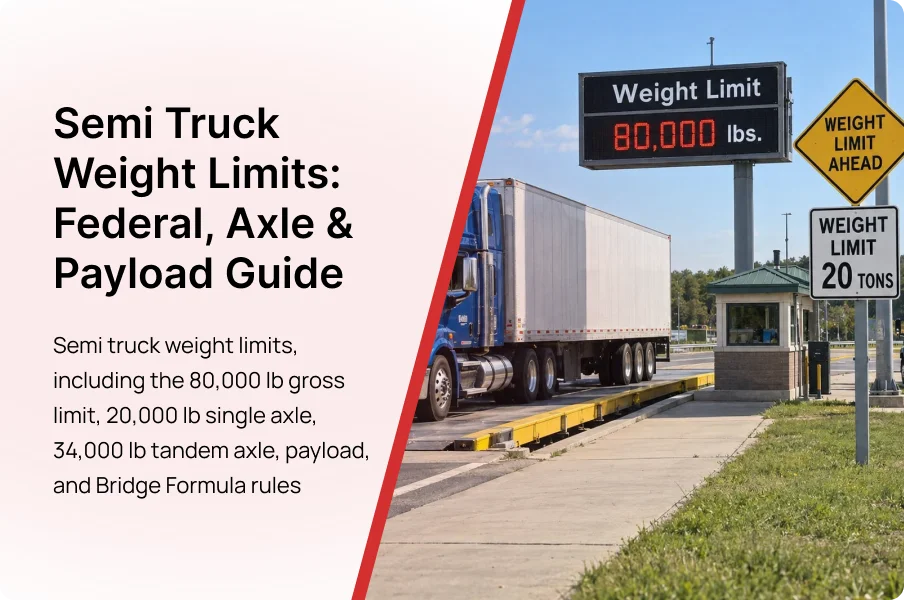
The standard federal weight limits for commercial vehicles operating on the U.S. Interstate System are 80,000 pounds gross vehicle weight, 20,000 pounds on a single axle, and 34,000 pounds on a tandem axle. The Federal Bridge Formula can impose a lower allowable weight based on axle count and axle spacing.
The 80,000-pound figure covers the tractor, trailer, fuel, equipment, and cargo. It is not an 80,000-pound freight allowance. A truck can also weigh less than 80,000 pounds and still be overweight because one axle group exceeds its limit or the vehicle fails the Bridge Formula.
State rules, grandfathered weight rights, road classifications, permits, and special vehicle or commodity provisions can change the applicable limit. Off the Interstate Highway System, states generally establish their own commercial-vehicle weight standards.
Compliance note: Truck weight rules depend on the vehicle configuration, axle spacing, highway, state, commodity, equipment, and permit status. Verify current Federal Highway Administration (FHWA), state DOT, permitting authority, and route-specific requirements before loading or dispatching a truck.
Semi Truck Weight Limits at a Glance
| Weight Category | Federal Standard or Planning Reference |
| Federal Interstate gross vehicle weight | 80,000 lb |
| Federal single-axle limit | 20,000 lb |
| Federal tandem-axle limit | 34,000 lb |
| Common empty tractor-trailer planning estimate | About 30,000–35,000 lb, depending on equipment |
| Nominal payload with a 34,000-lb empty combination | About 46,000 lb before axle checks |
| Common dry-van freight planning range | About 42,000–45,000 lb, depending on equipment and loading |
| Loads above ordinary limits | Require an applicable legal exception, grandfather right, or permit |
The first three figures are federal Interstate standards. The empty-weight and payload figures are operational planning estimates rather than statutory limits. Tractor specification, trailer type, fuel, auxiliary equipment, axle arrangement, and cargo position all affect actual usable payload.
FHWA states that the Bridge Formula applies in addition to the federal single-axle, tandem-axle, and gross-weight standards. A Bridge Formula calculation can therefore produce a lower allowable weight for an axle group.
What Does the 80,000-Pound Semi Truck Weight Limit Mean?
The 80,000-pound federal limit refers to gross vehicle weight, not cargo weight.
For a loaded tractor-trailer:
Tractor + Trailer + Fuel/Equipment + Cargo = Gross Vehicle Weight
A tractor and semitrailer consume part of the available gross weight before freight is loaded. The remaining amount represents nominal payload capacity, but axle and Bridge Formula limits can reduce the amount of freight the combination can legally carry.
Gross Weight vs. Payload vs. Tare Weight
Gross vehicle weight (GVW) is the actual weight of the complete vehicle or combination and its load.
Payload is the freight carried by the vehicle.
Tare or empty weight is the weight of the tractor, trailer, fuel, equipment, and other non-cargo components included in the operating combination.
Example:
- Tractor, trailer, fuel, and equipment: 34,000 lb
- Cargo: 45,000 lb
- Gross vehicle weight: 79,000 lb
The combination is 1,000 pounds below an 80,000-pound gross reference. That does not establish legal compliance. The steer axle, drive tandem, trailer tandem, applicable axle groups, and axle spacing must also comply.
What Counts Toward Gross Vehicle Weight?
Every component carried by the combination contributes to gross weight, including:
- tractor;
- semitrailer;
- fuel;
- auxiliary power unit;
- tools;
- tire chains;
- cargo-securement equipment;
- spare equipment;
- installed accessories; and
- freight.
A heavier tractor, trailer, fuel load, or accessory package leaves less gross-weight capacity available for cargo.
Is 80,000 Pounds the Truck’s Empty Weight?
No. 80,000 pounds is the standard federal Interstate gross-weight ceiling for ordinary operations, subject to the Federal Bridge Formula and applicable exceptions. It is not the normal empty weight of a tractor-trailer.
FHWA defines gross weight as the weight of the vehicle or vehicle combination plus its load. Federal law limits ordinary Interstate gross weight to 80,000 pounds, while the Bridge Formula can require a lower maximum for a particular axle group.
Does Every Semi Truck Automatically Get 80,000 Pounds?
No. Legal weight is determined by all applicable limits, not the gross figure alone.
Relevant factors include:
- number of axles;
- axle spacing;
- single-axle weight;
- tandem-axle weight;
- Federal Bridge Formula results;
- tire load limits;
- axle and vehicle ratings;
- highway classification;
- state law;
- grandfathered weight rights;
- permit conditions; and
- vehicle- or commodity-specific provisions.
For Interstate operation, the controlling legal weight can therefore be lower than 80,000 pounds because of the Bridge Formula or axle restrictions. Certain grandfathered or specially permitted operations can be treated differently under federal and state law.
How Much Does an Empty Semi Truck Weigh?
A tractor-trailer does not have one standard empty weight. About 30,000–35,000 pounds is a practical planning range for many highway tractor-trailer combinations, but actual tare weight must be determined from the specific equipment.
The number changes with the tractor, trailer, fuel level, installed equipment, and accessories.
Tractor Weight
Tractor weight depends on its configuration and specifications.
Relevant factors include:
- day cab or sleeper cab;
- wheelbase;
- engine and drivetrain;
- fuel-tank capacity;
- emission-control equipment;
- auxiliary power equipment;
- batteries;
- storage equipment; and
- installed accessories.
A heavier tractor reduces nominal cargo capacity pound for pound under the same gross-weight ceiling.
Trailer Weight
Trailer type also changes tare weight.
Examples include:
- dry vans;
- refrigerated trailers;
- flatbeds;
- tank trailers;
- container chassis; and
- specialized equipment trailers.
A refrigerated trailer carries refrigeration machinery and related components that a standard dry van does not. Even two 53-foot dry vans can have different empty weights because of floor construction, suspension, doors, aerodynamic equipment, materials, and specifications.
Fuel and Equipment Weight
Fuel is part of the truck’s operating weight and changes during the trip.
A tractor scaled with a partial fuel load becomes heavier after refueling. Load planning should therefore account for expected fuel and equipment rather than using only published tractor and trailer empty specifications.
Empty-Weight Payload Example
Assume:
Federal gross reference: 80,000 lb
Tractor + trailer + fuel + equipment: 34,000 lb
Nominal gross-weight room:
80,000 − 34,000 = 46,000 lb
The calculation shows that 46,000 pounds remains below the gross ceiling. It does not prove that 46,000 pounds of cargo can be carried legally.
Cargo placement still has to keep the steer axle, drive tandem, trailer tandem, and applicable Bridge Formula axle groups within their limits.
How Much Weight Can a Semi Truck Carry?
A semi truck’s nominal payload capacity equals the applicable gross-weight ceiling minus the weight of the tractor, trailer, fuel, equipment, and other non-cargo components.
Therefore:
80,000 lb gross vehicle weight ≠ 80,000 lb cargo capacity
A truck’s usable freight capacity can also be lower than its nominal gross capacity because axle distribution or axle spacing becomes the controlling factor.
How to Calculate Nominal Payload Capacity
Use:
Nominal payload = Applicable gross-weight ceiling − Operating weight before cargo
Example 1:
- Operating tractor-trailer weight: 33,500 lb
- Gross reference: 80,000 lb
80,000 − 33,500 = 46,500 lb
Example 2:
- Operating tractor-trailer weight: 35,500 lb
- Gross reference: 80,000 lb
80,000 − 35,500 = 44,500 lb
A 2,000-pound increase in equipment weight removes 2,000 pounds of nominal gross capacity available for cargo.
Typical Dry Van Payload
A freight weight around 42,000–45,000 pounds is a common planning range for standard dry-van operations.
That figure is not a federal dry-van cargo limit.
A lighter tractor-trailer combination can have more nominal gross capacity, while a heavier combination can have less. Axle distribution can also prevent the truck from using all of its theoretical gross capacity.
Why Semi Truck Payload Capacity Varies
Usable payload depends on factors such as:
- day cab versus sleeper tractor;
- tractor specification;
- trailer tare weight;
- fuel quantity;
- auxiliary equipment;
- cargo-securement equipment;
- fifth-wheel position;
- trailer tandem position;
- axle spacing;
- cargo center of gravity; and
- route-specific weight requirements.
Actual scale weights determine whether a specific load is distributed legally.
Payload Comparison Example
| Item | Truck A | Truck B |
| Tractor, trailer, fuel, and equipment | 32,500 lb | 36,000 lb |
| Gross reference | 80,000 lb | 80,000 lb |
| Nominal room before cargo | 47,500 lb | 44,000 lb |
Truck A has 3,500 pounds more nominal gross payload room.
Neither truck should automatically be loaded to its calculated maximum. Axle weights and the Bridge Formula still need to be checked.
Federal Semi Truck Axle Weight Limits
Federal Interstate weight rules regulate both total vehicle weight and the weight carried by individual axle groups.
The primary federal standards are:
- Single axle: 20,000 lb
- Tandem axle: 34,000 lb
- Gross vehicle weight: 80,000 lb
- Axle groups: Federal Bridge Formula limits
These standards remain part of the current federal Interstate weight framework.
Single Axle Weight Limit
The federal Interstate single-axle limit is 20,000 pounds, subject to applicable grandfathered rights and statutory exceptions.
For federal weight purposes, a single axle includes one or more axles whose centers are no more than 40 inches apart.
The 20,000-pound federal limit does not mean every axle should be loaded to 20,000 pounds. Tire capacity, axle ratings, manufacturer specifications, and state requirements can impose lower operating limits.
Tandem Axle Weight Limit
The standard federal Interstate tandem-axle limit is 34,000 pounds.
FHWA defines tandem-axle weight as the weight transmitted by two or more consecutive axles whose centers are more than 40 inches but no more than 96 inches apart.
A common five-axle tractor-semitrailer has:
- one steer axle;
- two drive axles forming a drive tandem; and
- two trailer axles forming a trailer tandem.
Each applicable axle group must comply independently.
Steer Axle Weight
A steer axle should not be described as having a universal 12,000-pound federal legal limit.
The 12,000-pound figure often appears in five-axle loading examples, including FHWA’s Bridge Formula illustrations, but the federal single-axle standard is 20,000 pounds. Actual steer-axle capacity can be limited by tire ratings, axle ratings, vehicle specifications, and state rules.
The legal operating limit is therefore not determined by a generic 12,000-pound number.
Drive Axle Weight
Drive tandems carry part of the tractor weight and a substantial share of the trailer and cargo load.
Changing cargo position or fifth-wheel position transfers weight toward or away from the drive axles. A drive tandem can therefore exceed 34,000 pounds even while gross vehicle weight remains below 80,000 pounds.
Trailer Axle Weight
Trailer tandems support the rear portion of the trailer and cargo.
Freight positioned too far toward the rear can increase trailer-tandem weight. Freight positioned farther forward transfers more weight toward the tractor’s drive axles.
Legal loading therefore requires both gross-weight control and axle-weight distribution.
Why Axle Weight Distribution Matters
A tractor-trailer is not automatically legal because its gross weight is below 80,000 pounds. Each applicable axle and axle group must also comply with its own limit and the Federal Bridge Formula.
Can a Truck Be Under 80,000 Pounds and Still Be Overweight?
Yes.
Consider:
- Steer axle: 11,500 lb
- Drive tandem: 35,000 lb
- Trailer tandem: 33,000 lb
Total:
11,500 + 35,000 + 33,000 = 79,500 lb
The truck is 500 pounds below an 80,000-pound gross reference.
Its drive tandem is 1,000 pounds above the standard 34,000-pound federal tandem limit.
The combination is therefore overweight on that axle group despite being under 80,000 pounds overall.
The Bridge Formula can create the same problem with internal axle groups. FHWA provides an example in which a five-axle truck weighs exactly 80,000 pounds but violates the Bridge Formula because four consecutive axles carry 68,000 pounds over a spacing that permits only 65,500 pounds.
Sliding Trailer Tandems
Sliding the trailer tandems changes how weight is distributed between the tractor’s drive axles and the trailer axle group.
The adjustment can:
- decrease weight on one tandem;
- increase weight on the other tandem; and
- change the spacing between axle groups.
The truck should be re-weighed after the tandem position changes.
Tandem position can also affect Bridge Formula calculations and state-specific dimensional or axle-position rules.
Adjusting the Fifth Wheel
The fifth wheel determines where part of the trailer’s weight transfers to the tractor.
Changing its position can redistribute weight between the steer axle and drive tandem. Any adjustment must remain within the tractor and fifth-wheel manufacturer’s specifications and applicable weight requirements.
How the Federal Bridge Formula Affects Semi Truck Weight
The Federal Bridge Formula determines the maximum weight allowed on groups of two or more consecutive axles based on axle count and axle spacing.
Congress established the formula to control the relationship between vehicle weight and length on bridges. Increasing axle count or spreading axles over a greater distance reduces concentrated loading on bridge structures.
The formula is:
W = 500 × [(L × N) / (N − 1) + 12N + 36]
Where:
- W = maximum weight for the axle group, expressed according to the federal rounding method;
- L = distance in feet between the outer axles in the group; and
- N = number of axles in the group.
The current federal statute contains this formula for Interstate vehicle-weight calculations.
Why the Number of Axles Matters
More axles distribute vehicle weight across more road-contact points.
Adding an axle does not create unlimited additional capacity. The combination still has to meet:
- single-axle limits;
- tandem-axle limits;
- Bridge Formula limits;
- gross-weight limits; and
- applicable state and equipment restrictions.
Why Axle Spacing Matters
Two trucks with identical gross weights can place different loads on a bridge because their axle spacing differs.
Greater spacing distributes the load across a larger distance. Shorter axle spacing concentrates more weight over a smaller section of the structure, which is why the Bridge Formula evaluates the distance between the outer axles of each relevant group.
Federal Bridge Formula Example
FHWA provides a five-axle example with 80,000 pounds gross weight.
For all five axles:
- axle count: 5
- outer-axle spacing: 51 feet
- actual weight: 80,000 lb
- allowable Bridge Formula weight: 80,000 lb
That group complies.
FHWA also checks axles 2 through 5:
- axle count: 4
- spacing: 35 feet
- actual weight: 68,000 lb
- Bridge Formula maximum: 65,500 lb
The internal group is 2,500 pounds overweight.
The example demonstrates why an 80,000-pound scale total is not a complete legal-weight test.
What Is the Maximum Weight for a 53-Foot Trailer?
A 53-foot trailer does not have one universal legal cargo-weight limit based on trailer length alone.
Legal road weight depends on the complete tractor-trailer combination, including:
- gross vehicle weight;
- tractor and trailer tare weight;
- single and tandem axle weights;
- axle spacing;
- cargo distribution;
- equipment ratings;
- highway classification;
- state rules; and
- permits or exceptions.
Federal weight standards regulate the vehicle combination and axle groups rather than assigning a universal freight limit to every 53-foot trailer.
Trailer Capacity vs. Legal Combination Weight
Trailer capacity refers to the weight the trailer is designed and rated to handle.
Legal combination weight refers to the weight the tractor, trailer, equipment, and cargo are legally allowed to place on the road.
A trailer could have sufficient structural capacity for a load while the complete combination exceeds a gross, tandem, single-axle, Bridge Formula, tire, equipment, route, or state limit.
Typical 53-Foot Dry Van Payload
Standard 53-foot dry-van loads are often planned in the low-to-mid 40,000-pound range, subject to the actual equipment.
Example:
- Tractor, trailer, fuel, and equipment: 33,000 lb
- Federal gross reference: 80,000 lb
Nominal room:
80,000 − 33,000 = 47,000 lb
That does not mean 47,000 pounds can always be loaded legally.
The cargo may create excessive drive-tandem or trailer-tandem weight before the combination reaches 80,000 pounds.
53-Foot Trailer Axle Limits
A trailer’s 53-foot length does not replace federal axle rules.
A tandem axle that falls within the federal tandem definition is generally subject to the 34,000-pound federal Interstate tandem limit, while the entire combination and its relevant axle groups must also satisfy the Federal Bridge Formula.
Can a Semi Truck Legally Exceed 80,000 Pounds?
Yes. 80,000 pounds is the standard federal Interstate baseline, not an absolute maximum for every legally authorized commercial-vehicle movement.
Federal law recognizes exceptions, including qualifying grandfathered operations and certain specially permitted non-divisible vehicles or loads.
Overweight Permits
States can issue permits for qualifying non-divisible vehicles or loads that exceed ordinary Interstate weight requirements.
FHWA defines a non-divisible load in part as a load or vehicle that cannot be separated into smaller loads without compromising its intended use, destroying its value, or requiring more than eight work hours to dismantle using appropriate equipment.
Permit conditions can regulate factors such as:
- approved routes;
- authorized dates;
- operating hours;
- maximum gross weight;
- axle weights;
- vehicle configuration;
- escorts;
- speed; and
- other movement restrictions.
A permit applies only according to its specific legal terms. Authorization for one load, vehicle, route, or date should not be treated as blanket permission for another movement.
Grandfathered and State-Specific Exceptions
Federal truck-weight law contains grandfather provisions that allow certain states or operations to retain weight rights that existed before later federal standards took effect.
State statutes also contain exemptions for particular vehicles, commodities, routes, and operating circumstances. FHWA’s state-law compilation documents examples involving agricultural commodities, timber, construction equipment, alternative-fuel vehicles, waste vehicles, government vehicles, and other specialized operations.
Semi Truck Weight Limits by State
Semi truck weight limits vary by state, especially outside the Interstate Highway System.
Federal weight standards apply to the Interstate System. FHWA states that individual states establish commercial-vehicle weight standards off the Interstate System.
State rules can differ in areas such as:
- gross vehicle weight;
- axle-group limits;
- bridge formulas;
- commodity exemptions;
- seasonal weight allowances;
- divisible-load provisions;
- non-divisible-load permits;
- designated truck routes;
- posted bridges; and
- local-road restrictions.
A multistate carrier must therefore check every relevant jurisdiction and route.
Federal vs. State Truck Weight Rules
| Issue | Federal Interstate Framework | State Role |
| Gross weight | Standard 80,000-lb framework | Enforcement, grandfathered provisions, and authorized exceptions |
| Single axle | 20,000 lb | State provisions and equipment restrictions can affect operation |
| Tandem axle | 34,000 lb | State-specific rules and exceptions can apply |
| Bridge Formula | Applies to relevant Interstate axle groups | States enforce federal requirements on the Interstate System |
| Non-Interstate roads | Federal Interstate weight standards do not govern every road | States establish applicable weight rules |
| Overweight permits | Federal law recognizes qualifying permitted movements | State agencies generally administer permits |
| Special commodities | Federal provisions can apply | State statutes can create specific exemptions |
Interstate vs. Non-Interstate Highways
Road classification changes the legal analysis.
A truck that is legal under a state highway rule is not automatically legal on the Interstate System. A truck legal on the Interstate also should not be assumed legal on every local road, bridge, or state route.
FHWA explains that the federal government regulates commercial vehicle weight on the Interstate System, while states retain authority to set weight standards on non-Interstate roads.
State Weight-Limit Research
Route-specific compliance should use current information from the relevant state DOT, highway agency, or permitting authority.
This applies in states such as:
- California;
- Texas;
- Florida;
- New York;
- Pennsylvania;
- Illinois;
- Georgia;
- Colorado; and
- every other jurisdiction through which the truck will travel.
State statutes and permit rules can change, so historical state-law compilations should not replace current state guidance.
How to Calculate Semi Truck Weight
Determining whether a tractor-trailer is overweight requires checking gross weight, axle weights, axle spacing, the Bridge Formula, and route-specific rules.
Step 1: Calculate Gross Vehicle Weight
Add the actual axle-group scale weights.
For a common five-axle tractor-trailer:
Steer axle + Drive tandem + Trailer tandem = Gross vehicle weight
Example:
11,800 + 33,400 + 33,700 = 78,900 lb
The combination is below 80,000 pounds.
The compliance check is not finished.
Step 2: Check the Steer Axle
Compare actual steer-axle weight with applicable:
- axle laws;
- tire load limits;
- gross axle weight ratings;
- vehicle specifications; and
- state requirements.
Do not apply a generic 12,000-pound steer number to every tractor.
Step 3: Check the Drive Tandem
Compare the drive-tandem scale weight with the applicable tandem limit.
For ordinary federal Interstate operation, the standard reference is:
34,000 lb
Step 4: Check the Trailer Tandem
Apply the same process to the trailer tandem.
Example:
- Steer: 11,500 lb
- Drives: 33,000 lb
- Trailer tandem: 34,500 lb
Gross weight:
11,500 + 33,000 + 34,500 = 79,000 lb
The gross weight is below 80,000 pounds, but the trailer tandem is 500 pounds above the standard 34,000-pound federal tandem figure.
Step 5: Check Axle Spacing and the Bridge Formula
Gross and tandem checks are not sufficient.
Identify:
- the number of axles in each relevant group; and
- the distance between the outer axles of that group.
Apply the Federal Bridge Formula where required.
FHWA confirms that a group of consecutive axles can violate the Bridge Formula even when the truck satisfies the gross, single-axle, and tandem limits.
Step 6: Check State and Route Rules
Review the actual route for:
- states crossed;
- Interstate segments;
- state highways;
- local roads;
- posted bridges;
- restricted routes;
- seasonal restrictions; and
- commodity-specific provisions.
Changing the route can change the applicable legal limit.
Step 7: Determine Whether a Permit Is Required
A load exceeding an ordinary legal limit should move only under a valid legal authority that applies to that load and route.
Determine permit eligibility before dispatch. An overweight load should not move based on an assumption that a permit can be obtained later.
Semi Truck Weight Calculator
A useful semi truck weight calculator should evaluate both gross weight and axle distribution.
Useful inputs include:
- tractor operating weight;
- trailer operating weight;
- fuel and equipment;
- cargo weight;
- steer-axle weight;
- drive-tandem weight;
- trailer-tandem weight;
- number of axles;
- axle spacing; and
- operating state or route.
Basic Gross-Weight Formula
Gross Vehicle Weight = Tractor + Trailer + Fuel/Equipment + Cargo
Example:
- Tractor: 19,000 lb
- Trailer: 14,000 lb
- Fuel and equipment: 1,500 lb
- Cargo: 44,500 lb
Calculation:
19,000 + 14,000 + 1,500 + 44,500 = 79,000 lb
Gross-weight result:
1,000 lb below an 80,000-lb reference
That result does not establish legal compliance.
A complete calculator should separately evaluate:
- gross-weight status;
- single-axle status;
- drive-tandem status;
- trailer-tandem status;
- Bridge Formula status;
- nominal remaining gross capacity; and
- state and route requirements.
A tool that only subtracts empty vehicle weight from 80,000 pounds is a payload estimator, not a complete truck legal-weight calculator.
What Happens If a Semi Truck Is Overweight?
An overweight tractor-trailer can face enforcement, financial, and operational consequences, but penalties vary by jurisdiction and circumstances.
Possible consequences include:
- roadside or weigh-station enforcement;
- citations;
- monetary penalties;
- required load redistribution;
- freight removal or transfer;
- movement restrictions until the violation is corrected;
- permit complications;
- route changes;
- missed appointments;
- delivery delays; and
- extra operating costs.
There is no single nationwide overweight fine that applies to every state and violation.
Weight regulation also protects transportation infrastructure. The Federal Bridge Formula specifically addresses how concentrated vehicle weight affects bridges.
How to Fix an Overweight Axle or Load
The correct adjustment depends on whether the problem is axle distribution, total gross weight, axle spacing, or another legal restriction.
Slide the Trailer Tandems
Sliding trailer tandems redistributes weight between the tractor drive tandem and trailer tandem.
After adjusting the tandems:
- secure the tandem mechanism;
- confirm the axle position;
- re-weigh the tractor-trailer; and
- verify applicable axle-spacing and state rules.
Tandem adjustment changes weight distribution. It does not reduce total vehicle weight.
Adjust the Fifth Wheel
Changing fifth-wheel position can redistribute weight between the steer axle and drive tandem.
The adjustment must stay within equipment specifications and applicable axle requirements.
Reposition the Cargo
Moving cargo forward or backward can change the load carried by each axle group.
Dense freight deserves particular attention because a relatively small change in cargo position can transfer substantial weight between the drive and trailer tandems.
Reduce the Cargo Weight
Removing freight is necessary when distribution adjustments cannot bring the truck within the applicable limits.
A truck that remains above its gross-weight limit cannot become legal simply by sliding its tandems. Redistribution changes where the weight is carried, not the total weight.
Re-Weigh the Combination
Verify every significant weight adjustment with a suitable scale.
Check:
- steer-axle weight;
- drive-tandem weight;
- trailer-tandem weight;
- gross vehicle weight; and
- relevant axle spacing.
The final compliance check should also cover the route, state requirements, Bridge Formula, equipment restrictions, and permit conditions.
Common Semi Truck Weight Mistakes
Treating 80,000 Pounds as Cargo Capacity
The 80,000-pound figure includes the truck and cargo together. Tractor, trailer, fuel, equipment, and freight all contribute to gross weight.
Checking Only Gross Vehicle Weight
A truck weighing 79,000 pounds can still exceed a single-axle, tandem-axle, or Bridge Formula limit.
Assuming a 53-Foot Trailer Has One Cargo Limit
Trailer length alone does not determine legal payload.
Tare weight, axle configuration, freight placement, vehicle gross weight, axle spacing, and route rules also matter.
Assuming Federal Limits Apply to Every Road
Federal commercial-vehicle weight standards apply to the Interstate System. States establish weight standards on non-Interstate roads.
Ignoring Axle Spacing
The Federal Bridge Formula uses both axle count and axle spacing. A vehicle can therefore satisfy ordinary gross and tandem figures but still violate a Bridge Formula limit.
Forgetting Fuel and Equipment
Fuel, APUs, tools, chains, securement equipment, and accessories consume weight that would otherwise be available for cargo.
Assuming “Under 80,000” Means Legal
Gross weight is only one part of the legal-weight calculation.
A tractor-trailer below 80,000 pounds can still be overweight because of an axle-group or Bridge Formula violation.
Final Takeaway
Semi truck weight compliance requires more than checking whether the scale reads less than 80,000 pounds.
For a typical Interstate tractor-trailer, start with these federal reference figures:
- 80,000 lb gross vehicle weight
- 20,000 lb single axle
- 34,000 lb tandem axle
The Federal Bridge Formula adds another limit based on the number and spacing of axles. State and route rules can change the legal calculation outside the Interstate System or under specific exemptions and permits.
A reliable loading sequence is:
Operating tractor-trailer weight → nominal payload → gross weight → axle weights → axle spacing and Bridge Formula → route and state requirements → permits or exceptions
Use the truck’s actual scale weights, actual axle spacing, equipment ratings, current route, current state requirements, and applicable permit conditions to determine whether a load is legal. A generic payload figure or an 80,000-pound gross total alone is not enough.
Frequently Asked Questions
Is 12,000 Pounds the Federal Steer Axle Limit?
No. The federal Interstate single-axle standard is 20,000 pounds. The 12,000-pound figure commonly appears in five-axle loading examples, but actual steer-axle limits can be lower because of tire capacity, axle ratings, vehicle specifications, and state requirements.
Does Fuel Reduce Semi Truck Payload Capacity?
Yes. Fuel contributes to gross and axle weight.
Adding 500 pounds of fuel and equipment reduces nominal gross payload room by approximately 500 pounds unless another part of the truck or load becomes lighter.
Can Sliding Tandems Fix a Grossly Overweight Truck?
No. Sliding tandems redistributes existing weight between axle groups.
A truck that exceeds its total legal gross weight needs weight removed or another lawful operating authorization. Moving the tandems does not change total gross vehicle weight.
Can a Semi Truck Carry 80 Tons?
80 tons equals 160,000 pounds, which is twice the standard 80,000-pound federal Interstate gross reference for an ordinary tractor-trailer.
Specialized heavy-haul combinations can operate at substantially higher weights under applicable permits, routes, vehicle configurations, and other legal conditions. A 160,000-pound load should never be treated as a standard semi-truck road weight or payload.
Can a Permitted Truck Exceed 80,000 Pounds?
Yes. Federal law permits states to authorize certain non-divisible vehicles or loads above normal Interstate weight limits, and grandfathered rights or other statutory provisions can also apply. The exact authorization depends on the load, vehicle, route, state, and permit conditions.
Are Truck Weight Limits the Same in Every State?
No. The federal standards govern Interstate operations, while states establish their own commercial-vehicle weight rules off the Interstate System. States can also have commodity exemptions, grandfathered provisions, seasonal rules, designated routes, posted bridges, and permit systems.